Costruire una classe JPulsante costituita da un cerchietto di 40 per 40 pixel con bordo nero ed interno giallo. Agganciare all’oggetto due ascoltatori di evento del mouse: mouseEntered e mouseExited in modo che passandoci sopra il mouse il pulsante diventi con lo sfondo rosso, e togliendovi da sopra il mouse lo sfondo ritorni giallo. Suggerimento: definire un attributo boolean “over” true/false per registrare lo stato del mouse (sopra o non sopra l’oggetto).
Esercizi in preparazione alla verifica
- Costruire una classe che disegni una scacchiera bianca e nera di dimensione massima 256×256 pixel
- Costruire una classe che serva a rappresentare su un istogramma a rettangoli di colori diversi l’andamento di un titolo azionario durate i vari giorni della settimana; definire gli attributi rend1, rend2, etc. per ogni giorno della settimana.
JOxy
package assicartesiani;

import java.awt.Dimension;
import java.awt.FontMetrics;
import java.awt.Graphics;
import java.awt.Graphics2D;
import java.awt.RenderingHints;
import javax.swing.JComponent;

public class JOxy extends JComponent {

    private int scalaX, scalaY, traslX, traslY;
    private String asseX, asseY;

    public JOxy() {
        setPreferredSize(new Dimension(400, 400));
        setScalaX(50);
        setScalaY(50);
        setTraslX(40);
        setTraslY(40);
        setAsseX("X");
        setAsseY("Y");
    }

    public int xg(double x) {
        return (int) Math.round(getTraslX() + x * getScalaX());
    }

    public int yg(double y) {
        return (int) Math.round(getHeight() - 1 - getTraslY() - y * getScalaY());
    }

    public double xr(int x) {
        return (double) (x - getTraslX()) / getScalaX();
    }

    public double yr(int y) {
        return (double) (getHeight() - 1 - getTraslY() - y) / getScalaY();
    }

    @Override
    public void paintComponent(Graphics g) {
        int w = getWidth() - 1;
        int h = getHeight() - 1;
        Graphics2D g2 = (Graphics2D) g;
        g2.setRenderingHint(RenderingHints.KEY_ANTIALIASING, RenderingHints.VALUE_ANTIALIAS_ON);
        g2.setFont(getFont());
        FontMetrics fm = g2.getFontMetrics();

        g2.setColor(getBackground());
        g2.fillRect(0, 0, w, h);
        g2.setColor(getForeground());

        // asse x
        g2.drawLine(0, yg(0), w, yg(0));
        g2.drawLine(w - 20, yg(0) - 10, w, yg(0));
        g2.drawLine(w - 20, yg(0) + 10, w, yg(0));
        for (int x = -getTraslX() / getScalaX(); x < (w - getTraslX()) / getScalaX(); x++) {
            g2.drawLine(xg(x), yg(0) - 5, xg(x), yg(0) + 5);
            String xs = x + "";
            g2.drawString(xs, xg(x) - fm.stringWidth(xs) / 2, yg(0) + 5 + fm.getHeight());
        }
        g2.drawString(getAsseX(), w - 5 - fm.stringWidth(getAsseX()), yg(0) - 15 - fm.getDescent());

        // asse y
        g2.drawLine(xg(0), h, xg(0), 0);
        g2.drawLine(xg(0) - 10, 20, xg(0), 0);
        g2.drawLine(xg(0) + 10, 20, xg(0), 0);
        for (int y = -getTraslY() / getScalaY(); y < (h - getTraslY()) / getScalaY(); y++) {             g2.drawLine(xg(0) - 5, yg(y), xg(0) + 5, yg(y));             String ys = y + "";             g2.drawString(ys, xg(0) - 10 - fm.stringWidth(ys), yg(y) + fm.getAscent() / 2);         }         g2.drawString(getAsseY(), xg(0) + 15, fm.getHeight());     }     public int getScalaX() {         return scalaX;     }     public final void setScalaX(int scalaX) {         if (scalaX >= 20) {
            this.scalaX = scalaX;
            repaint();
        }
    }

    public int getScalaY() {
        return scalaY;
    }

    public final void setScalaY(int scalaY) {
        if (scalaY >= 20) {
            this.scalaY = scalaY;
            repaint();
        }
    }

    public int getTraslX() {
        return traslX;
    }

    public final void setTraslX(int traslX) {
        if (traslX >= 0) {
            this.traslX = traslX;
            repaint();
        }
    }

    public int getTraslY() {
        return traslY;
    }

    public final void setTraslY(int traslY) {
        if (traslY >= 0) {
            this.traslY = traslY;
            repaint();
        }
    }

    public String getAsseX() {
        return asseX;
    }

    public final void setAsseX(String asseX) {
        if (asseX != null) {
            this.asseX = asseX;
        } else {
            this.asseX = "";
        }
    }

    public String getAsseY() {
        return asseY;
    }

    public final void setAsseY(String asseY) {
        if (asseY != null) {
            this.asseY = asseY;
        } else {
            this.asseY = "";
        }
    }

}
JCirconferenza
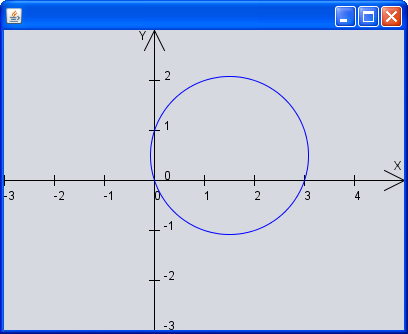
import java.awt.Color;
import java.awt.Graphics;

public class JCirconferenza extends JOxy {

    private double a, b, c;

    public JCirconferenza() {
        setA(0.0);
        setB(0.0);
        setC(-1.0);
    }

    @Override
    public void paintComponent(Graphics g) {
        super.paintComponent(g);
        double xC = -getA()/ 2.0;
        double yC = -getB()/ 2.0;
        double r = Math.sqrt(xC * xC + yC * yC - getC());
        g.setColor(Color.BLUE);
        g.drawOval(xg(xC - r), yg(yC + r), (int) Math.round(2.0 * r * getScalaX()), (int) Math.round(2.0 * r * getScalaY()));
    }

    public double getA() {
        return a;
    }

    public final void setA(double a) {
        this.a = a;
        repaint();
    }

    public double getB() {
        return b;
    }

    public final void setB(double b) {
        this.b = b;
        repaint();
    }

    public double getC() {
        return c;
    }

    public final void setC(double c) {
        this.c = c;
        repaint();
    }
}
JParabola
import java.awt.Graphics;

public class JParabola extends JOxy {

    private double a, b, c;

    public JParabola() {
        setA(1.0);
        setB(0.0);
        setC(0.0);
    }

    @Override
    public void paintComponent(Graphics g) {
        super.paintComponent(g);
        int w = getWidth() - 1;
        double x0 = 0.0, y0 = 0.0;
        for (int i = 0; i < w; i++) {
            double x = xr(i);
            double y = getA() * x * x + getB() * x + getC();
            if (i == 0) {
                x0 = x;
                y0 = y;
            } else {
                g.drawLine(xg(x0), yg(y0), xg(x), yg(y));
                x0 = x;
                y0 = y;
            }
        }
    }

    public double getA() {
        return a;
    }

    public final void setA(double a) {
        this.a = a;
        repaint();
    }

    public double getB() {
        return b;
    }

    public final void setB(double b) {
        this.b = b;
        repaint();
    }

    public double getC() {
        return c;
    }

    public final void setC(double c) {
        this.c = c;
        repaint();
    }

}
Logo Peano
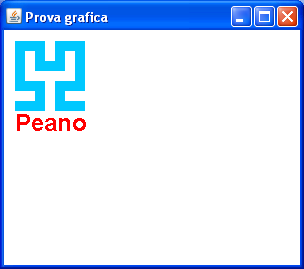
public class JLogo extends JComponent {

    public JLogo() {
        setPreferredSize(new Dimension(80, 100));
    }

    @Override
    public void paintComponent(Graphics g) {
        Graphics2D g2 = (Graphics2D) g;
        g2.setColor(new Color(0, 200, 255));
        g2.setStroke(new BasicStroke(10.0f));
        int[] x = {10, 30, 30, 10, 10, 30, 30, 50, 50, 70, 70, 50, 50, 70};
        int[] y = {70, 70, 50, 50, 10, 10, 30, 30, 10, 10, 50, 50, 70, 70};
        g2.drawPolyline(x, y, x.length);
        g2.setFont(new Font("Arial", Font.BOLD, 24));
        g2.setColor(Color.RED);
        g2.drawString("Peano", 5, 95);
    }

}
Grafica in Java

Cartella compressa contenente il progetto NetBeans con gli esempi: Canvas [ZIP]
OperatoriSuiBit.java
public class OperatoriSuiBit {

    public static String bin(int i) {
        return Integer.toBinaryString(i)+"b";
    }

    public static void main(String[] args) {
        int a, b, c;

        System.out.println("Operatori logici");
        a = 10; System.out.println("a = "+a+" = "+bin(a));
        b = 12; System.out.println("b = "+b+" = "+bin(b));
        c = a & b; System.out.println("c = a & b = "+c+" = "+bin(c));
        c = a | b; System.out.println("c = a | b = "+c+" = "+bin(c));
        c = ~a; System.out.println("c = ~a = "+c+" = "+bin(c));

        System.out.println();

        System.out.println("Operatori di spostamento");
        a = 20; System.out.println("a = "+a+" = "+bin(a));
        c = a << 2; System.out.println("c = a << 2 = "+c+" = "+bin(c));
        c = a >> 2; System.out.println("c = a >> 2 = "+c+" = "+bin(c));
        c = a >>> 2; System.out.println("c = a >>> 2 = "+c+" = "+bin(c));
        b = -20; System.out.println("b = "+b+" = "+bin(b));
        c = b << 2; System.out.println("c = b << 2 = "+c+" = "+bin(c));
        c = b >> 2; System.out.println("c = b >> 2 = "+c+" = "+bin(c));
        c = b >>> 2; System.out.println("c = b >>> 2 = "+c+" = "+bin(c));
    }
}
Materiale didattico per la 3ª E – CSS
Classe 1ª I – Esercizio sulla propagazione degli errori
Calcolare con relativo errore il volume di un cilindro di raggio r = (12,05±0,05) mm ed altezza h = (27,15±0,01) mm
A = π r² = π r r
V = A h
π = 3,1415926
A = 456,167 mm²
ΔA = (0+Δr/r+Δr/r) A = 3,786 mm²
V = 12’384,9 mm³ = 12,3849 cm³
ΔV = (3,786/456,167+0,01/27,15) 12’384,9 = 107,4 mm³ = 0,1074 cm³
V = (12,4±0,1) cm³
E% = 0,8 %