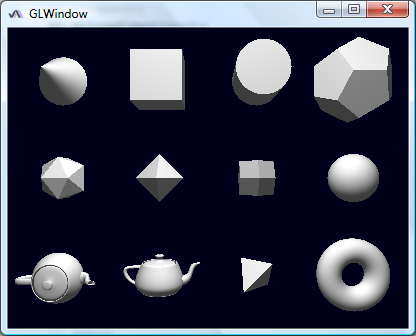
In questo primo esempio tridimensionale vengono utilizzati i solidi predefiniti della libreria GLUT. Viene impostata una sorgente di luce e le caratteristiche del materiale degli oggetti. Per capire il funzionamento dei parametri per la luce e i materiali o l’effetto delle trasformazioni geometriche è utile provare a modificare i valori numerici. Se si avvia l’animazione i solidi ruotano tutti intorno al proprio asse x.
Per i dettagli fare riferimento a: Computer Graphics with OpenGL
- CG 1. Introduction to OpenGL
- CG 2. Computer Graphics – Basic Theory
- CG 3. OpenGL Examples
- References & Resources
GLRenderer.java
public class GLRenderer implements GLEventListener {

    float a = 0.0f;

    @Override
    public void init(GLAutoDrawable drawable) {
        GL2 gl = drawable.getGL().getGL2();

        float[] ambiente = new float[]{1, 1, 1, 1};
        float[] diffusa = new float[]{1, 1, 1, 1};
        float[] speculare = new float[]{1, 1, 1, 1};
        float[] posizione = new float[]{0, 10, 10, 1};

        // imposta le caratteristiche della sorgente di luce 0
        gl.glLightfv(GL2.GL_LIGHT0, GL2.GL_AMBIENT, ambiente, 0);
        gl.glLightfv(GL2.GL_LIGHT0, GL2.GL_DIFFUSE, diffusa, 0);
        gl.glLightfv(GL2.GL_LIGHT0, GL2.GL_SPECULAR, speculare, 0);
        gl.glLightfv(GL2.GL_LIGHT0, GL2.GL_POSITION, posizione, 0);
        // attiva la sorgente di luce 0
        gl.glEnable(GL2.GL_LIGHT0);
        // attiva l'iluminazione
        gl.glEnable(GL2.GL_LIGHTING);
        // attiva il test di profondità per disegnare solo parti visibili
        gl.glEnable(GL2.GL_DEPTH_TEST);
        // imposta il colore di sfondo
        gl.glClearColor(0, 0, 0.1f, 0);
    }

    @Override
    public void dispose(GLAutoDrawable drawable) {
    }

    @Override
    public void display(GLAutoDrawable drawable) {
        GL2 gl = drawable.getGL().getGL2();
        GLUT glut = new GLUT();

        // cancella l'immagine e il buffer per il test di profondità
        gl.glClear(GL2.GL_COLOR_BUFFER_BIT | GL2.GL_DEPTH_BUFFER_BIT);

        // cono
        gl.glLoadIdentity();
        gl.glTranslatef(-6, 4, 0);
        gl.glRotatef(a, 1, 0, 0);
        glut.glutSolidCone(1, 2, 36, 10);

        //cubo
        gl.glLoadIdentity();
        gl.glTranslatef(-2, 4, 0);
        gl.glRotatef(a, 1, 0, 0);
        glut.glutSolidCube(2);

        // cilindro
        gl.glLoadIdentity();
        gl.glTranslatef(2, 4, 0);
        gl.glRotatef(a, 1, 0, 0);
        glut.glutSolidCylinder(1, 2, 36, 10);

        // dodecaedro
        gl.glLoadIdentity();
        gl.glTranslatef(6, 4, 0);
        gl.glRotatef(a, 1, 0, 0);
        glut.glutSolidDodecahedron();

        // icosaedro
        gl.glLoadIdentity();
        gl.glTranslatef(-6, 0, 0);
        gl.glRotatef(a, 1, 0, 0);
        glut.glutSolidIcosahedron();

        // ottaedro
        gl.glLoadIdentity();
        gl.glTranslatef(-2, 0, 0);
        gl.glRotatef(a, 1, 0, 0);
        glut.glutSolidOctahedron();

        // rombidodecaedro
        gl.glLoadIdentity();
        gl.glTranslatef(2, 0, 0);
        gl.glRotatef(a, 1, 0, 0);
        glut.glutSolidRhombicDodecahedron();

        // sfera
        gl.glLoadIdentity();
        gl.glTranslatef(6, 0, 0);
        gl.glRotatef(a, 1, 0, 0);
        glut.glutSolidSphere(1, 36, 18);

        // teiera vista dall'alto
        gl.glLoadIdentity();
        gl.glTranslatef(-6, -4, 0);
        gl.glRotatef(a, 1, 0, 0);
        glut.glutSolidTeapot(1, false);

        // teiera vista di fianco
        gl.glLoadIdentity();
        gl.glTranslatef(-2, -4, 0);
        gl.glRotatef(a, 1, 0, 0);
        glut.glutSolidTeapot(1, true);

        // tetraedro
        gl.glLoadIdentity();
        gl.glTranslatef(2, -4, 0);
        gl.glRotatef(a, 1, 0, 0);
        glut.glutSolidTetrahedron();

        // toro
        gl.glLoadIdentity();
        gl.glTranslatef(6, -4, 0);
        gl.glRotatef(a, 1, 0, 0);
        glut.glutSolidTorus(0.5, 1, 36, 36);

        // incrementa l'angolo di rotazione di 1°
        a += 1.0f;
    }

    @Override
    public void reshape(GLAutoDrawable drawable, int x, int y, int w, int h) {
        GL2 gl = drawable.getGL().getGL2();
        GLU glu = new GLU();

        // imposta la matrice di trasformazione per la proiezione
        gl.glMatrixMode(GL2.GL_PROJECTION);
        gl.glLoadIdentity();
        glu.gluPerspective(45, (float) w / h, 5, 50);
        glu.gluLookAt(0, 0, 15, 0, 0, 0, 0, 1, 0);

        // imposta la matrice di trasformazione per gli oggetti
        gl.glMatrixMode(GL2.GL_MODELVIEW);
        gl.glLoadIdentity();
    }

}
Progetto Eclipse: EclipseJOGL.zip
N.B.: È probabile che sia necessario eliminare la libreria JOGL2 presente nel progetto e sostituirla con quella del proprio Workspace.